
Decision Excellence – Improving Management Decisions in B2B Organisations

Better decisions require more than better information
Management decisions are rarely based on facts alone.
They are made under time pressure, with incomplete information, competing objectives and different perspectives. Established routines, organisational dynamics and unconscious biases can all influence how options are assessed and decisions are reached.
Simply collecting more data or conducting another analysis is therefore not always enough.
Mind your business helps management teams improve how important decisions are prepared, discussed, made and implemented.
We combine practical management experience with analytical structure, process understanding and de-biasing expertise to make decision-making more effective in everyday business.
When decision quality becomes a challenge
Decision quality deserves attention when important topics are discussed extensively but decisions still fail to produce the desired outcomes.
Typical situations include:
Important decisions are repeatedly postponed or reopened after agreement,
Discussions focus on details without clarifying the actual decision to be made,
Assumptions, risks or conflicting objectives remain insufficiently challenged,
Certain perspectives dominate while relevant alternatives receive too little attention,
Decisions are formally made but lack commitment or effective follow-through.
The underlying problem is often not a lack of management competence. Organisations may need clearer decision criteria, better preparation and processes that make different perspectives productive.
How Mind your business supports better decisions
Effective decision-making requires more than sound analysis.
It also depends on how decisions are framed, who is involved, which information is considered and how discussions are conducted.
Mind your business examines how decisions actually emerge within your organisation. We identify where relevant questions are overlooked, where assumptions influence outcomes and where processes or management routines can be improved.
The objective is not to make decision-making more complicated. It is to ask the right questions earlier and establish a more effective basis for decisions and implementation
Our work helps organisations:
Define decision questions and responsibilities more clearly,
Make assumptions and the underlying logic of decisions more transparent,
Evaluate alternatives, risks and conflicting objectives more systematically,
Make management and decision meetings more effective,
Recognise and address relevant biases and group dynamics.
Typical challenges and areas of improvement
Organisations make decisions every day, ranging from operational priorities to major investments or strategic choices.
Five areas frequently offer opportunities for improvement.

Clarifying the decision question
Make sure everyone is working on the same decision.
Many decision processes begin with a question that appears straightforward.
As discussions progress, however, it may become clear that participants have different interpretations of the problem, the available options or the expected outcome.
We help clarify the actual decision, its scope, relevant responsibilities and the criteria against which alternatives should be assessed.

Reviewing decision foundations
Challenge the information and assumptions behind important choices.
Business cases, analyses and financial models often appear more objective than they really are.
They depend on assumptions, selected data, forecasts and interpretations. These need to be understood and challenged, particularly when decisions involve substantial uncertainty or long-term consequences.
We review whether the information is relevant, which assumptions matter most and where additional perspectives or risk assessments are needed.

Making decision meetings more effective
Turn discussions into clearer decisions and actions.
Many important management decisions are prepared or made in meetings.
These meetings are influenced by more than information. Roles, hierarchies, communication patterns, expectations and group dynamics all shape the discussion.
Mind your business can observe, review and help improve decision meetings so that they become more focused, balanced and effective.

Identifying biases and blind spots
Make unconscious influences more visible.
Experience, routines and established thinking patterns help managers act efficiently. However, they can also create systematic blind spots.
We identify where assumptions, cognitive biases or group dynamics may influence the interpretation of information, the assessment of alternatives or the willingness to challenge existing views.
De-biasing provides practical approaches to reducing these risks.

Strengthening decision follow-through
Connect decisions with responsibility and implementation.
A formally approved decision does not automatically lead to the intended outcome.
Effective implementation requires clarity about responsibilities, communication, progress reviews and how changing circumstances should be addressed.
We help organisations strengthen the connection between decision-making and the actions that follow.
Better decisions often start with better questions
Rather than looking for immediate answers, it can be valuable to address questions such as:
- What decision actually needs to be made?
- Which criteria matter most, and are they understood by everyone involved?
- Which assumptions, uncertainties or conflicting objectives shape our perspective?
- Which relevant alternatives or viewpoints have not yet been considered?
- How will we know whether the decision has delivered the intended result?
Addressing these questions earlier and more openly can improve the quality of management discussions.
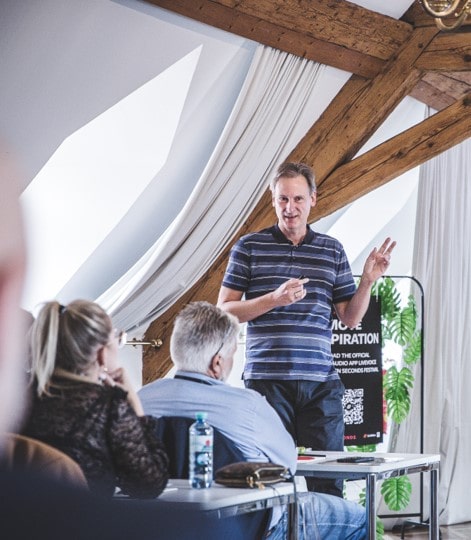
Why decision-making can be biased
Even experienced management teams do not make decisions independently of human behaviour.
Time pressure, previous successes, organisational politics, hierarchies and group expectations can influence how information is interpreted and options are discussed.
Typical situations include:
Initial assessments become anchors that are difficult to challenge,
Information supporting an existing view receives more attention than contradictory evidence,
Projects continue mainly because substantial resources have already been invested,
Critical voices are not involved or are heard too late,
Groups reach apparent agreement before alternatives have been adequately considered.
De-biasing does not mean eliminating all mistakes or removing human judgement.
It means recognising recurring patterns that can undermine decision quality and developing more robust approaches to making decisions.
Mind your business integrates de-biasing where it can strengthen decision processes, management discussions and implementation.
Learn more about De-biasing
Experience in real management decisions
Improving decision quality requires an understanding of both business logic and the realities of management.
Markus Eckhart brings more than 25 years of corporate and leadership experience in international B2B organisations. His background combines finance, strategy, B2B marketing, business planning, performance management and implementation.
He has experienced decision-making from different perspectives: as a manager, controller, business partner, member of management teams, project leader, advisor and de-biasing specialist.
This combination is particularly valuable when decisions involve complex business cases, competing interests, several organisational functions or difficult implementation conditions.
The focus is not on abstract decision theory, but on improving real management situations with limited time, imperfect information and significant responsibility.
More about Markus Eckhart

How we work together
The right approach depends on whether the focus is on a specific decision, recurring management meetings or an established decision-making process.
Our work typically follows three steps.

1. Clarify the starting point
We discuss the decision, meeting or process concerned, the business context and the outcome you want to achieve.
This establishes a shared understanding of the challenge and its relevance.

2. Review the current approach
We examine how decisions are currently prepared, discussed, made and followed through.
Depending on the situation, this may involve reviewing decision materials, observing meetings, analysing process steps or exploring relevant assumptions and group dynamics.

3. Develop practical improvements
Based on the findings, we develop appropriate improvements together (e.g. decision criteria, information requirements, meeting formats, de-biasing measures,...).
The objective is to create improvements your organisation can put into practice and sustain.
Possible ways of working
Decision Excellence can be approached through a focused review, a practical intervention or a broader improvement project.
Three formats are particularly useful.
- Decision Review:
A structured review of an important decision. We examine the decision question, available information, underlying assumptions, alternatives, criteria and relevant risks.
Suitable when: An important management decision needs stronger preparation or an independent critical perspective. - Decision Meeting Observation:
An external perspective on how management decisions are actually made. We observe a selected meeting and reflect on decision preparation, discussion quality, participation, group dynamics and follow-through.
Suitable when: Your management team wants to identify blind spots and improve the effectiveness of important meetings. - Decision Process Improvement:
Improving a recurring decision-making process. We assess and develop the way decisions are prepared, discussed, approved and implemented, including relevant responsibilities, governance and decision routines.
Suitable when: Decision-making repeatedly creates delays, inconsistent outcomes or implementation problems.
Additional ways of working
Depending on your needs, further approaches can be integrated:
Decision scans to identify recurring weaknesses or error patterns,
Bias audits to examine assumptions, cognitive biases and group dynamics,
Reviews of business cases, investment decisions and management information,
Workshops and training on decision quality and de-biasing,
Ongoing Management Advisory to support decisions and implementation over time.
Explore Process Consulting | Explore Management Advisory
What better decision quality can deliver
Better decision quality does not mean every decision becomes easy or that uncertainty disappears.
It means important questions are addressed earlier, assumptions are challenged more consciously and the consequences of decisions are better understood.
Potential benefits include:
Clearer decision questions, responsibilities and criteria,
More systematic consideration of assumptions, risks and alternatives,
More focused and productive decision meetings,
Greater awareness of biases and unhelpful group dynamics,
Decisions with stronger commitment and more effective follow-through.
This creates a better basis for consistent decisions and meaningful implementation.
Who Decision Excellence is designed for
Our work is particularly relevant for:
Executive management and management teams,
Leaders responsible for cross-functional decisions,
Finance, controlling and performance management professionals,
Strategy, project and transformation leaders,
Teams seeking to improve decision meetings and recurring decision processes.
The primary focus is on industrial, process-driven and internationally active B2B organisations.
Frequently asked questions
What others say about our collaboration
Markus has consistently demonstrated a great ability to coordinate, handle and leverage the multiple strong personalities surrounding him, making sure that the group energy was always conveyed toward reaching ambitious goals
Andrea Baldini – Head of Pricing
Improve decision quality in your organisation
Are important decisions taking too long, are management meetings producing limited results, or are decision-making processes not delivering the outcomes you expect?
Let's discuss where better decision quality could make the greatest difference and which approach would suit your organisation.
For broader process improvement projects, explore Process Consulting. For ongoing management support, explore Management Advisory.